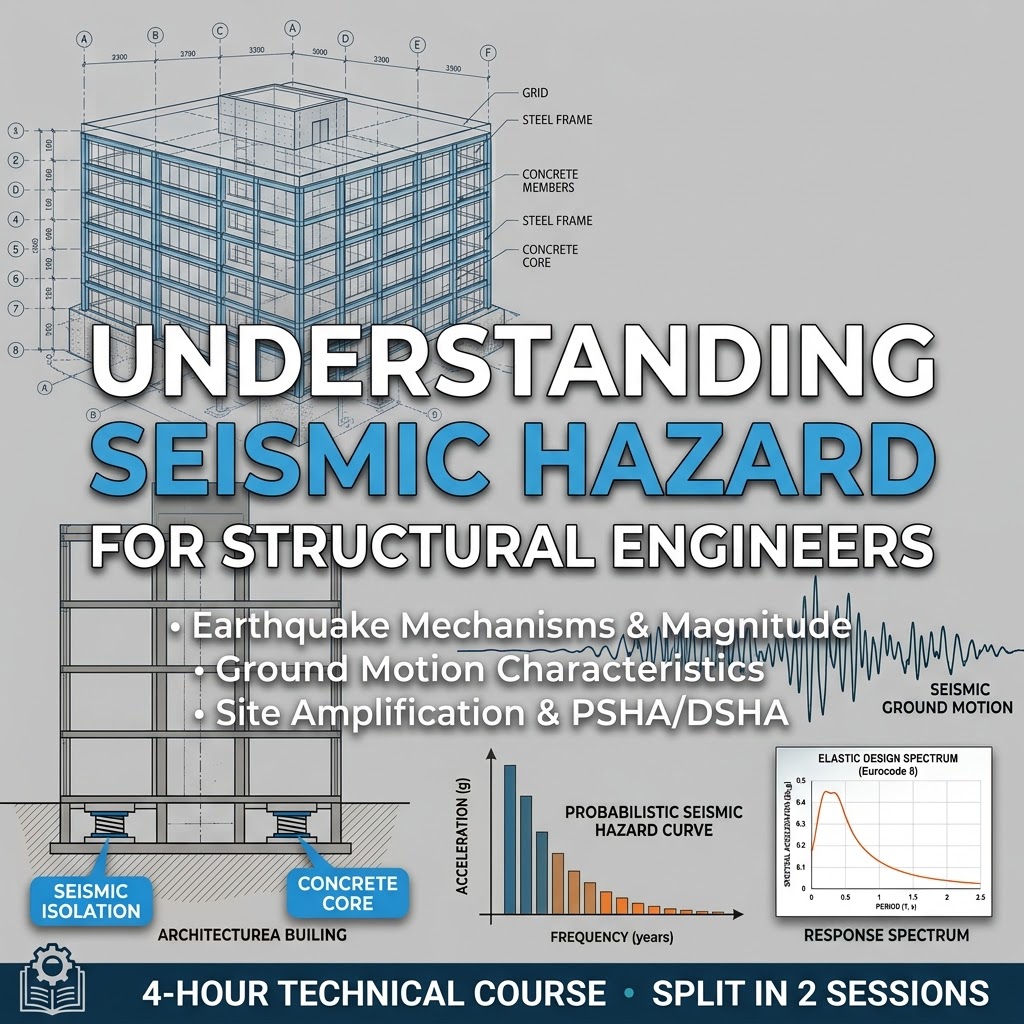

Course Overview
Seismic hazard assessment is a critical first step in modern structural design, governing how actions are defined before structural analysis even begins. Designed specifically for civil and structural engineers, this 4-hour intensive course breaks down the fundamentals of earthquake engineering, ground motion characteristics, and seismic hazard analysis into clear, practical engineering concepts.
Delivered across two 2-hour interactive sessions, this course equips delegates with a clear understanding of earthquake mechanisms, site-specific ground motion changes, and how seismic hazard maps and response spectra are derived for practical design.
Session 1: Introduction
to Earthquake Engineering & Ground Motion Characteristics (2 Hours)
Module 1: Fundamentals of Earthquake Engineering
Plate tectonics, fault rupture mechanisms, and seismic wave propagation .
Quantifying seismic events: Intensity (MMI) vs. Magnitude
Quantifying seismic events: Intensity (MMI) vs. Magnitude and energy release.
Structural performance lessons and engineering observations from historic
seismic events.
Module 2: Ground Motion Characteristics & Local Site Effects
Key ground motion parameters: Peak Ground Acceleration (PGA), Peak Ground
Velocity (PGV), and frequency content.
Factors influencing motion: Rupture distance, focal depth, and directivity
effects.
Local soil amplification: How site geology alters ground motion (Eurocode 8 /
ASCE 7 site classifications).
Session 2: Seismic Hazard Analysis & Response Spectra (2 Hours)
Module 3: Seismic Hazard Assessment Frameworks
Principles and applications of Deterministic Seismic Hazard Analysis (DSHA).
Fundamentals of Probabilistic Seismic Hazard Analysis (PSHA) and earthquake
recurrence models.
Interpreting seismic hazard curves, return periods
Structural performance lessons and engineering observations from historic
seismic events.
Module 2: Ground Motion Characteristics & Local Site Effects
Key ground motion parameters: Peak Ground Acceleration (PGA), Peak Ground
Velocity (PGV), and frequency content.
Factors influencing motion: Rupture distance, focal depth, and directivity
effects.
Local soil amplification: How site geology alters ground motion (Eurocode 8 /
ASCE 7 site classifications).
Session 2: Seismic Hazard Analysis & Response Spectra (2 Hours)
Module 3: Seismic Hazard Assessment Frameworks
Principles and applications of Deterministic Seismic Hazard Analysis (DSHA).
Fundamentals of Probabilistic Seismic Hazard Analysis (PSHA) and earthquake
recurrence models.
Interpreting seismic hazard curves, return periods and Uniform Hazard Spectra (UHS).
Module 4: Elastic Response Spectra & Design Inputs
Derivation and physical meaning of Single-Degree-of-Freedom (SDOF) elastic
response spectra.
Translating seismic hazard outputs into structural design codes (EN 1998 /
Eurocode 8).
Selection and scaling considerations for ground motion records in dynamic
analysis.
Derivation and physical meaning of Single-Degree-of-Freedom (SDOF) elastic response spectra.
Translating seismic hazard outputs into structural design codes (EN 1998 / Eurocode 8).
Selection and scaling considerations for ground motion records in dynamic analysis.
- Navigate and interpret seismic hazard maps and probability-based return periods.
- Evaluate local site conditions to select appropriate soil amplification factors.
- Construct and extract design spectral accelerations for structural analysis inputs.
Key Learning Outcomes
Navigate and interpret seismic hazard maps and probability-based return periods.
- Evaluate local site conditions to select appropriate soil amplification factors.
- Construct and extract design spectral accelerations for structural analysis inputs.